

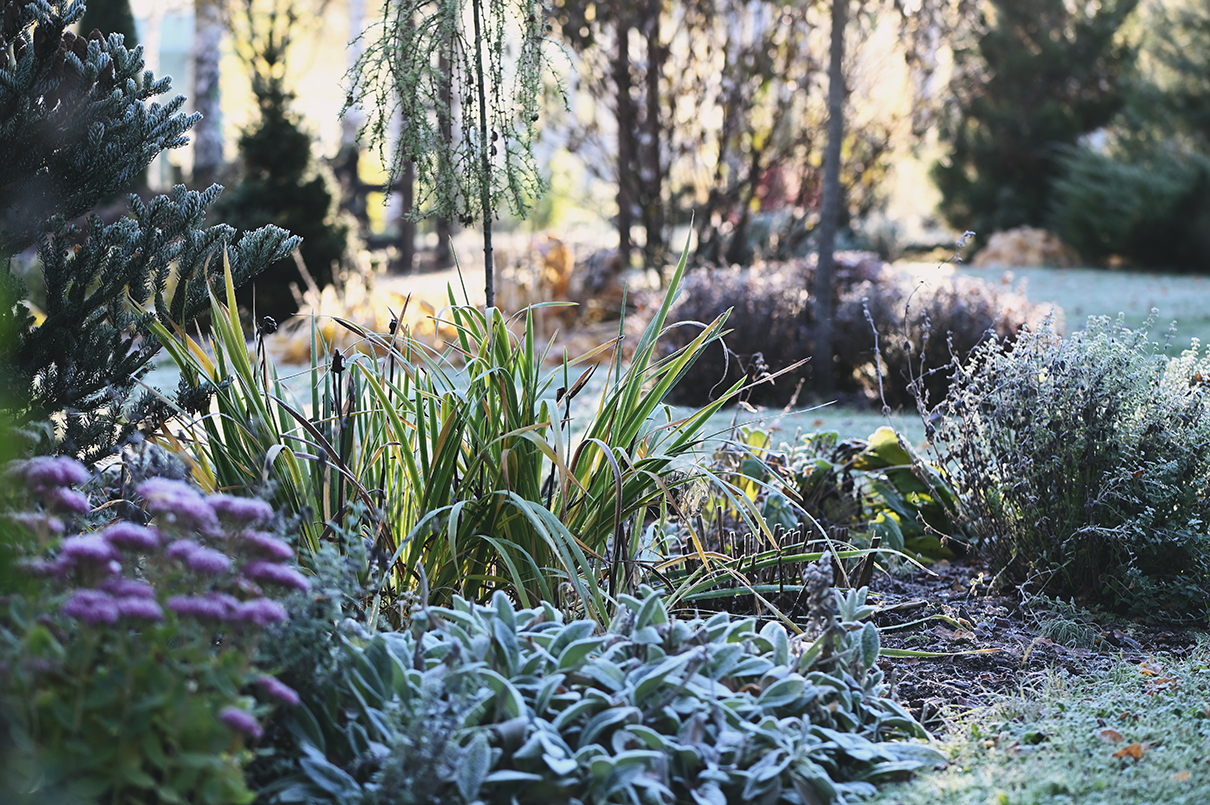
As we inch closer to the coldest months it’s a time of quiet and reflection in the garden, writes Elly West.
It’s also a time when we can really appreciate the plants that earn their space outside of the fanfare of summer, whether it’s for their scent, colour, texture or form – or in some fortunate cases, all of the above.
Year-round interest is on the wish-list for most of my clients when I’m designing a garden or border, and a well-planned garden shouldn’t be bleak and bare in winter. Flowers may be few and far between, but this is the time when berries, seed-heads, evergreens, interesting bark and colourful stems bring their own special beauty, especially when dusted with frost and sparkling in the winter sunshine.
A good rule-of-thumb when choosing plants for your garden is to make sure at least 25% of them are looking good in each season. Invariably spring and summer will dominate, with new bulbs popping up, fresh leaves unfurling and flowers blooming, but when you’re deciding what to plant, consider what will be happening in autumn and winter as well. Evergreen plants will provide structure all year round. Topiary yew, clipped hedges and variegated shrubs such as euonymus, hebe and pittosporum are all solid backbone plants for a winter garden. However, too many evergreens can feel static and lacking in seasonal variation. Add to these by choosing summer-flowering plants with a long season of interest, as many will continue to look attractive once the flowers have faded.
Plant of the month: Skimmia
Skimmia japonica ‘Rubella’ is a tough and easy-to-grow shrub with year-round appeal. It has a compact rounded form and glossy evergreen leaves, adding structure all year, but it is in late autumn and winter that it comes into its own, when the vibrant deep-red flower buds appear. These open to white, long-lasting, fragrant flowers in spring.
Both ‘Rubella’ (male) and the berried female forms are readily found in the seasonal displays in garden centres right now. While small, it makes a great centrepiece for a winter container display, perhaps accompanied by some trailing small-leaved ivies and dainty cyclamen. Grown in a border, it forms a compact and slow-growing shrub, eventually reaching around a metre or more in height and spread. Skimmia grows best in shade or partial shade, as full sun can cause the leaves to go yellow. Make sure it doesn’t dry out, particularly in the first year or so after planting, as it prefers moist soil. It can also be grown as an informal hedge. ‘Kew Green’ is another attractive version with lime-green buds opening to creamy yellow flowers.

Hydrangeas, echinacea, phlomis, honesty, globe thistles, sea hollies and poppies all have attractive seed heads, so don’t be in a rush to cut them back at the end of the summer, as they will provide structure and interest through the colder months as well. Wildlife will also benefit from this lower-maintenance approach, which provides much needed food and shelter for birds and small mammals in the colder months. The more you leave, the greater the variety you’ll provide to cater for different creatures. Birds will enjoy the seeds of many different plants including sunflowers, honeysuckle, asters and cardoons; and beneficial insects and their larvae will find homes in old stems and seed heads.
Autumn and winter are also the months to enjoy colourful berries, and among the most striking are those of Callicarpa bodinieri. It’s jewel-like berries are an unusual vivid mauve-purple with a metallic lustre, and hang in clusters on the bare branches after the leaves have fallen. Pyracantha, holly, cotoneaster and sorbus are all good choices for winter berries. Don’t forget roses too, as many will produce beautifully coloured hips that attract birds to the garden, and can be cut and used in flower arrangements.
Trees with interesting bark and shrubs with colourful stems are another highlight of the winter garden. During summer they may fade into the background, but when the show is over they’ll provide much-needed colour and interest. Dogwoods (Cornus) are easy to grow and look great in drifts or dotted around the garden at regular intervals. There are varieties with red, green, yellow, black and purple stems – or look out for ‘Midwinter Fire’, with multi-coloured red, yellow and orange stems. Among my favourite trees for their bark are Himalayan birch (Betulis utilis subsp. jacquemontii), with silver-white bark that almost glows on a winter’s day, and paperbark maple (Acer griseum), which has cinnamon-coloured bark that peels in thin, paper-like layers.
Flowers may be thin on the ground as we move towards winter, but there are still plenty of plants to choose from that will bring cheery blooms, whether it’s in a container or in the border. Primulas, pansies and violas are readily available in trays from the garden centre or supermarket, and are perfect for a splash of colour in a pot by the front door. Hellebores, winter jasmine, witch hazel, wintersweet, flowering quince, mahonia, viburnum, forsythia, skimmia and daphne are all gearing up to shine in winter. Many winter flowers are super-strongly scented as well, in order to attract the few pollinators that are around. I have a lot of sweet box (Sarcococca confusa) in my garden, which largely goes ignored in the summer, but in winter its glossy green leaves and starry white flowers that fill the air with sweet fragrance give me a reason to go outside whatever the weather.
I love using ornamental grasses in borders, mixed with perennials and shrubs, to add movement and also for their long season of interest. If you have the space, go tall, as the fronded plumes are more likely to catch the low winter light. Miscanthus sinensis has airy plumed seed heads from August right through until January or even longer, fading from gold to a silver-grey and reaching 2m or more in height. There are some attractive variegated and dwarf forms as well.
A smaller grass that cries out to be touched is Stipa tenuissima, or Mexican feather grass, which has particularly soft, feathery fronds. At around 60cm tall, it can be squeezed into just about any space and is also happy in containers.
Elly West is a professional garden designer, working in and around the Bath and Bristol areas; find her at ellyswellies.co.uk